

India’s digital lending journey has been dramatic over the past few years. Not long ago, getting a personal loan meant visiting a bank branch, filling long forms, and waiting days for approval. Today, someone can download an app, verify their identity in minutes, and receive money in their bank account the same day. At the center of this shift are partnerships between NBFCs and fintech platforms. That is exactly why the recent decision around Default Loss Guarantees has generated so much discussion across the financial sector. For lenders, startups, and even investors, Default Loss Guarantees indicate that digital lending in India is not being rolled back but carefully structured. For borrowers, the change may not look dramatic on the surface, but its impact will be real. Over the last two years, confusion and fear surrounded digital loan apps. Some shut down, others restricted operations, and many customers suddenly found credit harder to access.
The Reserve Bank of India has now clarified how risk sharing should work. Instead of blocking innovation, it has drawn a boundary line so companies know what they can and cannot do. The RBI’s updated framework on Default Loss Guarantees finally provides legal clarity to a system that already existed in practice. In simple terms, fintech companies often bring borrowers to NBFCs. They handle the app, onboarding, and credit assessment using technology. But the money still comes from a regulated lender. The Default Loss Guarantees rule allows a fintech partner to compensate the lender for a small percentage of losses if borrowers fail to repay. However, the loan remains fully owned by the regulated entity. This is important because it keeps accountability with licensed institutions while allowing digital platforms to keep operating.
RBI Restores Default Loss Guarantees
| Aspect | Key Information |
|---|---|
| Regulator | Reserve Bank of India |
| Policy Focus | Risk sharing in digital lending partnerships |
| Mechanism | Fintech provides a capped default loss guarantee to NBFC |
| Guarantee Limit | Up to 5% of total loan portfolio |
| Loan Ownership | Stays with NBFC or bank |
| Borrower Disclosure | Mandatory identification of actual lender |
| Recovery Rights | Only regulated lender can recover dues |
| Credit Reporting | Loans must be reported to credit bureaus |
| Safeguards | Escrow account, compliance audits, due diligence |
| Objective | Encourage innovation while protecting customers |
Why The RBI Stepped In
To understand this decision, it helps to look at what was happening earlier. After 2020, digital lending exploded. Lockdowns pushed people toward online services and credit demand increased sharply. Small ticket loans became especially popular among young professionals, gig workers, and first-time borrowers. However, problems also appeared quickly. Thousands of complaints reached regulators. Some borrowers reported being harassed by recovery agents. Others were shocked by high interest rates hidden behind processing charges. Many people did not even know the name of the NBFC lending them money. The RBI realized the issue was not digital lending itself. The issue was responsibility. When a borrower defaulted, nobody was clearly accountable. The fintech blamed the lender and the lender blamed the platform. Default Loss Guarantees solve that confusion by defining exactly who carries what risk.
What Exactly Has Changed
The RBI did not simply approve risk sharing. It created strict rules.
- First, the fintech can only cover up to 5 percent of total loan losses. This ensures they participate in risk but cannot act like an unregulated bank.
- Second, the NBFC must conduct its own credit checks. It cannot blindly rely on an algorithm created by a partner.
- Third, borrowers must be clearly informed about the lender’s name before accepting the loan.
- Fourth, all loans must be reported to credit bureaus. That means repayment behavior will affect a borrower’s credit score.
Because of these steps, Default Loss Guarantees now function as a controlled risk sharing tool rather than a loophole.
RBI Restores Default Loss Guarantees: Relief for NBFCs
For NBFCs, this announcement brings major relief. Many lenders had slowed partnerships with fintech apps due to regulatory uncertainty. Unsecured digital loans are attractive because they grow quickly, but they also carry higher default rates. Now lenders get partial protection. If a borrower fails to repay, the fintech partner absorbs a limited portion of the loss. That encourages lenders to expand lending again, especially to customers in smaller cities where traditional banking penetration is low. Another advantage is customer acquisition. Fintech platforms already have millions of users. Instead of building expensive branch networks, NBFCs can reach customers digitally. Default Loss Guarantees make that expansion safer.
What It Means for Fintech Companies
For fintech startups, the decision is extremely important. Their business model depends on partnerships with regulated lenders. Without regulatory clarity, investors were hesitant to fund expansion. The framework allows fintech companies to continue innovating. They can design user friendly apps, automate KYC verification, and build data based underwriting models. But their role is now clearly defined. They are facilitators, not lenders. Because they share a portion of losses, fintech firms must improve credit evaluation. If they onboard risky borrowers, they will pay part of the cost. In the long run, this could actually strengthen the industry by encouraging responsible lending practices.
Impact On Borrowers
Borrowers are the biggest beneficiaries, even though they may not notice immediately.
- Earlier, customers often dealt only with an app. When problems occurred, they struggled to find a real office or authority. Now, every borrower must be told the name of the regulated lender. That means they have a clear point of contact.
- Interest rates and charges must also be disclosed upfront. This reduces hidden fees. Recovery practices must follow regulated procedures, which should reduce harassment complaints.
- Another important benefit is credit history. Since loans are reported to credit bureaus, timely repayment helps build a strong credit score. That can later help borrowers qualify for larger loans like education or housing finance.
Compliance And Safeguards Introduced
The RBI did not stop at risk sharing. It introduced several safeguards along with Default Loss Guarantees.
- The first is the escrow requirement. Guarantee funds must be kept in a separate account so they cannot be misused.
- The second is independent underwriting. NBFCs must verify borrower eligibility themselves.
- The third is audit tracking. All decisions must be recorded and reviewable.
- The fourth is grievance redressal. Borrowers can complain directly to the regulated lender and escalate unresolved complaints to the regulator.
Together, these measures bring transparency to digital lending.
Risks And Concerns That Still Remain
Despite the positive reaction, challenges remain. Some lenders feel the 5 percent cap may not be sufficient for high risk borrowers. Small ticket instant loans often see higher default rates. Fintech companies also face increased compliance costs. They must invest in legal processes, reporting systems, and data protection. Approval speed may slow slightly because lenders will conduct additional checks. However, regulators seem willing to accept slower growth in exchange for stability. The goal is to prevent a future credit bubble rather than fix a crisis later.
What Happens Next
Industry experts expect lending activity to rise again. Embedded finance, where loans are offered inside shopping apps or payment platforms, will likely expand in 2026. Many NBFCs that paused partnerships may resume operations. The biggest growth could come from smaller cities. Digital onboarding allows lenders to reach customers who never had formal credit access before. With Default Loss Guarantees in place, lenders feel confident taking calculated risks. Investors also see this as positive. A clear regulatory framework reduces uncertainty and encourages funding in fintech startups.
RBI Restores Default Loss Guarantees: The Bottom Line
The RBI has taken a balanced approach. It did not shut down digital lending, and it did not leave it unregulated. Instead, it clarified accountability.
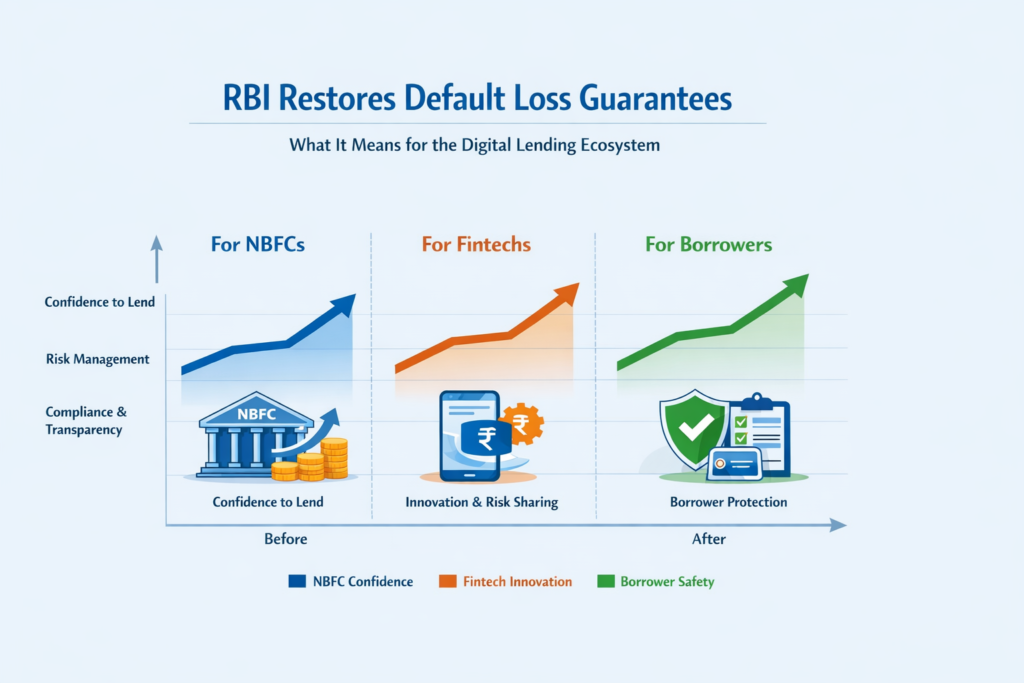
- NBFCs can expand lending with controlled risk.
- Fintech companies can innovate responsibly.
- Borrowers get transparency and protection.
Default Loss Guarantees may sound technical, but their real meaning is simple. India’s digital lending sector now has clear rules. And when rules are clear, trust grows. Trust is what ultimately determines whether a financial system expands safely.
Read More:-
EPFO’s New App Just Made EPF Withdrawals Instant—Here’s How You Can Get Your Money via UPI Today
FAQs on RBI Restores Default Loss Guarantees
1. What are Default Loss Guarantees
They are arrangements where a fintech partner covers a small portion of losses if borrowers’ default, while the regulated lender still owns the loan.
2. Who is the real lender in digital lending partnerships
The NBFC or bank remains the official lender responsible for compliance and recovery.
3. How will this affect loan apps
Legitimate apps will continue operating but must follow stricter transparency and compliance rules.
4. Is this good for borrowers
Yes. Borrowers receive clear disclosures, formal complaint channels, and better protection from unfair recovery practices.