
The Union Public Service Commission (UPSC) released the official UPSC CMS 2026 Notification on March 11, 2026, announcing 1,358 vacancies for various medical officer positions within the Government of India. Eligible MBBS graduates can now apply through the commission’s official website for the Combined Medical Services (CMS) Examination, which remains a primary gateway to Grade-A and Grade-B healthcare careers in the central civil services.
UPSC CMS 2026
| Feature | Details |
| Total Vacancies | 1,358 Posts |
| Primary Eligibility | MBBS Degree (Passed or Final Year) |
| Application Deadline | March 31, 2026 (6:00 PM IST) |
| Written Exam Date | August 2, 2026 |
| Exam Mode | Computer Based Test (CBT) |
| Selection Stages | Written CBT (500 marks) + Personality Test (100 marks) |
Overview of the UPSC CMS 2026 Notification
The 2026 recruitment drive aims to fill critical healthcare roles across several central departments. According to the official notification, the vacancies are divided into two distinct categories. Category I focuses on the Central Health Service (CHS), while Category II includes roles within the Indian Railways, the New Delhi Municipal Council (NDMC), and the Municipal Corporation of Delhi (MCD).
A spokesperson for the commission stated that the examination is designed to ensure a “merit-based selection of qualified medical professionals to bolster the nation’s public health infrastructure.” Candidates must complete their applications by the deadline of March 31, 2026, at 6:00 PM.
Eligibility Criteria and Age Relaxations
To qualify for the Combined Medical Services examination, applicants must have passed the written and practical parts of the final MBBS examination. Those currently completing their final year internship are also permitted to apply, provided they complete their requirements before the final selection phase.
The age limit for candidates is strictly monitored. For most positions, applicants must not have attained the age of 32 years as of August 1, 2026. However, for the Medical Officers Grade in the Central Health Service, the upper age limit is extended to 35 years. Standard government relaxations apply for reserved categories, including a five-year extension for SC/ST candidates and three years for OBC applicants.
Examination Structure and Technical Syllabus
The selection process involves a two-stage evaluation. The first stage is a computer-based examination scheduled for August 2, 2026. This stage consists of two objective-type papers, each carrying 250 marks.
Paper I: Clinical Domain (250 Marks)
Paper I focuses heavily on internal medicine and paediatrics. Candidates are expected to demonstrate proficiency in identifying systemic diseases, metabolic disorders, and neonatal care protocols. The inclusion of 30 questions specifically on Paediatrics underscores the government’s focus on maternal and child health outcomes.
Paper II: Surgical and Social Medicine (250 Marks)
This paper is broader, encompassing Surgery, Gynaecology & Obstetrics, and Preventive & Social Medicine (PSM). PSM often acts as a tie-breaker for many candidates, as it tests knowledge of national health programmes, environmental health, and epidemiology—skills vital for a Medical Officer in the public sector.
“The rigorous nature of the CMS exam ensures that only those with a deep grasp of clinical practice and public health enter the service,” noted Dr. R.K. Prasad, a retired administrative medical officer. Following the written results, successful candidates will undergo a 100-mark Personality Test to assess their leadership and suitability for administrative roles.
Career Progression and The DACP Scheme
One of the most attractive features highlighted in the UPSC CMS 2026 Notification is the assured career path. Under the Dynamic Assured Career Progression (DACP) scheme, medical officers receive promotions based on years of service, independent of vacancy availability at higher levels.
A Medical Officer joining at Pay Level 10 can expect to reach the rank of Chief Medical Officer (CMO) within 13 to 20 years. This stability is a significant draw compared to the volatility of private practice. Furthermore, ADMOs in the Railways enjoy unique benefits, including residential quarters and travel passes, making it a highly sought-after cadre.
The Role of Public Service in Modern Healthcare
Beyond the salary and perks, the CMS officer plays a pivotal role in implementing the Ayushman Bharat Digital Mission and other frontline healthcare initiatives. Officers are often stationed in major urban hubs or railway hospitals, acting as the primary link between the government’s policy and the patient’s bedside.
For many, this is a path to specialize without the immediate pressure of the NEET-PG. The central services allow for “Study Leave,” enabling officers to pursue post-graduation after a few years of dedicated service, with the assurance that their seniority remains intact.
Important Deadlines for Applicants
- Registration Opens: March 11, 2026
- Registration Closes: March 31, 2026 (18:00 IST)
- Correction Window: April 1 to April 7, 2026
- Admit Card Release: Expected mid-July 2026
- Exam Date: August 2, 2026
Application Process via OTR
Candidates must use the One-Time Registration (OTR) platform on the UPSC website to submit their forms. The commission has emphasized that the OTR profile must be updated with accurate information, as any discrepancies could lead to disqualification.
Step-by-Step Submission:
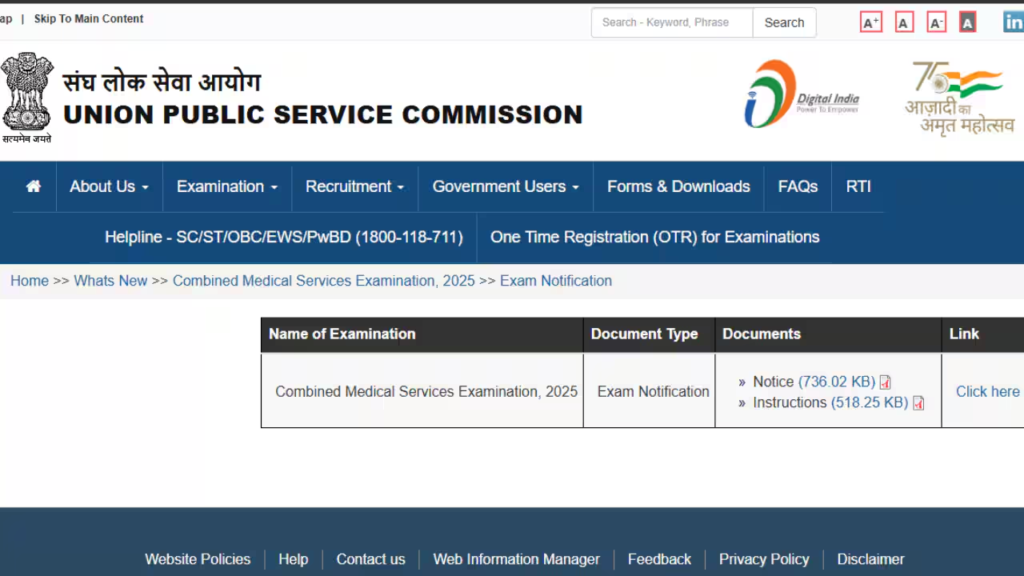
- OTR Setup: If new, register at
upsconline.nic.in. - Dashboard Login: Access the CMS 2026 link under “Active Examinations.”
- Document Verification: Upload a valid ID (Aadhar, Voter ID, or Passport). The same ID must be carried to the exam hall.
- Fee Payment: A non-refundable fee of ₹200 is required for General, EWS, and OBC male candidates.
- Exemptions: Females and candidates from SC/ST/PwBD categories are exempted from all application fees.
Conclusion: A Strategic Window for Medical Graduates
The UPSC CMS 2026 Notification represents a stable, prestigious, and impactful alternative to clinical residency. With 1,358 spots available, the 2026 cycle is one of the largest in recent years. Prospective officers are advised to begin their preparation immediately, focusing on the integrated syllabus that bridges clinical knowledge with administrative acumen.
As the healthcare landscape in India continues to formalize, the role of a Combined Medical Services officer remains indispensable. Success in this examination not only secures a lifelong career but also offers the opportunity to lead the nation’s health departments during a period of significant technological and infrastructural growth.