
The financial markets rarely move in clean, predictable patterns. Yet over the past year investors have watched something especially unusual unfold stocks climbing aggressively while the currency that normally benefits from economic strength shows hesitation. The S&P 500 keeps setting records, corporate earnings remain stable, and recession fears continue to fade. At the same time, the US Dollar Safe-Haven Status is no longer behaving the way it historically has. Instead of strengthening alongside American financial optimism, the currency has periodically softened even during periods of global uncertainty. This contradiction has forced investors to rethink long-held assumptions about how capital flows into the United States. For decades, global money moved into America for two reasons safety and growth. Investors trusted U.S. companies for profits and trusted the currency for protection. Now those motivations appear to be separating. The US Dollar Safe-Haven Status is being questioned not because the U.S. economy is weak, but because global markets are evolving. Capital today has more destinations, and investors are no longer relying exclusively on one defensive asset.
The stock rally is therefore telling one story about confidence, while the currency market is telling another about diversification. The conversation around the US Dollar Safe-Haven Status has intensified because market behavior no longer follows its traditional pattern. In previous cycles, when U.S. equities performed strongly, foreign investors bought both American stocks and dollars simultaneously. Now, capital is entering equities but not always remaining in the currency. This suggests investors want exposure to American businesses rather than automatic exposure to American cash holdings. The dollar still plays a central role in finance, but traders increasingly compare it with gold, high-yield bonds, and select international currencies when planning defensive strategies. Interest rate expectations, real yields, and global trade flows have become just as important as economic growth when evaluating whether the dollar acts as a refuge.
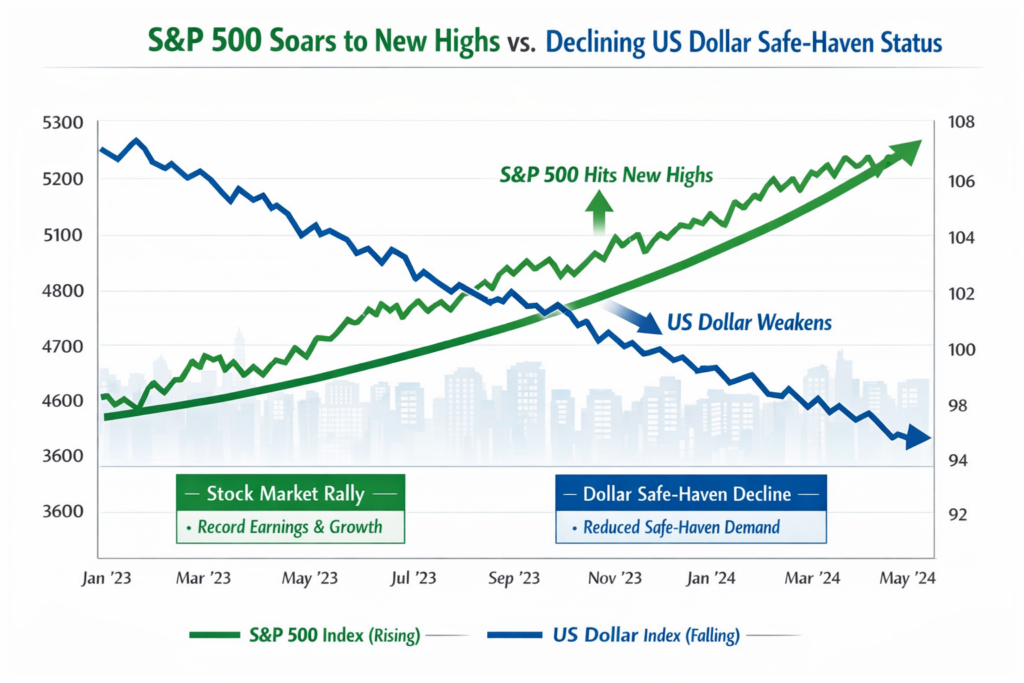
S&P 500 Soars to New Highs
| Key Factor & Market Driver | Current Development & Trend | Effect On Dollar | Investor Behavior |
|---|---|---|---|
| S&P 500 Performance & Corporate Earnings | Record highs driven by technology and strong balance sheets | Reduces need for defensive currency demand | Funds shift into equities |
| Federal Reserve Policy & Rate Outlook | Inflation cooling & potential rate cuts expected | Weakens yield advantage | Diversification away from USD |
| Global Economic Recovery & Trade Expansion | Europe & Asia stabilizing | Less dependence on dollar | Foreign asset allocation rises |
| Gold Prices & Commodities | Gold rising alongside stocks | Competes with dollar protection | Increased hedging activity |
| Inflation & Real Yields | Real yields narrowing | Lower incentive to hold cash | Investment in risk assets |
| Treasury Yields & Bond Demand | Yields stabilizing | Carry trade appeal declines | Reduced currency accumulation |
The financial world is not witnessing the fall of the dollar. Instead, it is witnessing a transition. The S&P 500 rally shows faith in corporate strength and economic resilience, while currency behavior reflects a broader diversification of global capital. The US Dollar Safe-Haven Status remains important, but it is no longer automatic. Investors now separate growth investments from protection strategies. Rather than relying on a single asset for security, they are spreading risk across multiple instruments.
S&P 500 At Record Levels
- The stock market rally is rooted in measurable fundamentals rather than speculation. Corporate earnings, particularly in artificial intelligence, semiconductors, and cloud computing sectors, have outperformed expectations. Companies have managed higher borrowing costs by improving efficiency, restructuring debt, and maintaining pricing power. This matters because confidence reduces fear. When investors trust the economy, they stop prioritizing protection. The US Dollar Safe-Haven Status relies heavily on fear-driven demand. Without widespread anxiety, fewer investors feel the need to park cash in defensive holdings.
- Institutional investors are also reallocating. Pension funds, sovereign funds, and asset managers are increasing exposure to equities as economic data remains resilient. Consumer spending, employment levels, and service sector growth continue supporting earnings expectations. Retail investors play a role too. Passive investing through index funds and retirement accounts channels steady flows into stocks. These flows support valuations and further reinforce confidence a cycle that naturally pulls demand away from safe-haven assets.
What’s Pressuring The Dollar
The dollar is not collapsing. Instead, it is experiencing subtle structural pressure.
- One major factor is diversification. Central banks are gradually reducing the percentage of reserves held exclusively in dollars. They are adding gold and other currencies to reduce concentration risk. Even a small shift matters because reserve holdings are enormous.
- Another factor is global trade settlement. Increasingly, countries are completing trade transactions in local currencies rather than defaulting to the dollar. Energy agreements, regional partnerships, and bilateral trade arrangements are slowly changing settlement patterns.
- Yield competition also plays a role. Investors constantly compare returns across countries. When other economies offer attractive yields, global capital reallocates. This trend directly affects the US Dollar Safe-Haven Status because the currency depends on consistent foreign demand for U.S. assets.
Interest Rates and the Federal Reserve
- Interest rate expectations are one of the strongest drivers of currency movements. During the period of aggressive monetary tightening, higher interest rates made holding dollars attractive. Investors could earn reliable returns from Treasury securities. Now the outlook is shifting. Inflation has moderated compared to peak levels, and markets expect future rate cuts. Even before policy changes occur, anticipation alone affects currency pricing.
- When investors believe yields will decline, they reposition early. Lower expected returns reduce incentives to hold dollars, weakening demand. As real yields compress, capital flows toward equities, commodities, and international markets. This is one of the most significant forces behind the changing US Dollar Safe-Haven Status. It is not a sudden loss of confidence it is a forward-looking adjustment to future interest rate expectations.
Global Capital Flows And Alternatives
- Global finance today is more interconnected and competitive than it was twenty years ago. Investors have access to deeper foreign markets, more liquid bond exchanges, and advanced payment systems that facilitate international investment. Europe’s bond markets have strengthened. Asian markets have expanded rapidly. Emerging economies now offer credible alternatives for yield-seeking investors. None individually replaces the dollar, but together they reduce dependence on it.
- Gold has also regained attention. Central banks worldwide have increased gold purchases as a reserve diversification strategy. Gold serves a similar purpose to a safe-haven currency: stability during uncertainty. As a result, the US Dollar Safe-Haven Status is evolving from exclusive to comparative. Investors are no longer choosing between safety and risk; they are choosing among several types of protection.
Inflation And Real Yields
- Real yield the return after adjusting for inflation often determines currency attractiveness. When real yields are high, investors favor holding that currency. When real yields fall, demand weakens. For several years, the United States maintained a strong real yield advantage. Now that advantage is shrinking as inflation cools and rate expectations decline.
- This environment allows multiple assets to rise simultaneously. Stocks benefit from growth optimism. Gold benefits from hedging demand. Commodities benefit from global recovery. Meanwhile, currency demand becomes more selective. The shift further illustrates how the US Dollar Safe-Haven Status is changing. Investors still trust the dollar, but they no longer depend on it as their only protection.
What Could Reverse the Trend
Despite current changes, the dollar retains unique strengths: liquidity, transparency, and unmatched financial depth. During severe crises, investors historically return to it quickly. Events that could restore strong dollar demand include global recession, banking system instability, major geopolitical conflict, and a sharp equity market crash. In extreme situations, investors prioritize immediate liquidity. The dollar remains the most accessible currency in the world. Therefore, its safe-haven role may not disappear it may simply activate only during major shocks rather than routine uncertainty.
The Bigger Market Implication
- The evolving relationship between stocks and currencies changes how investors build portfolios. Previously, holding U.S. assets provided both growth and protection simultaneously. Now those roles are separating. Modern portfolio strategy increasingly includes equities for long-term growth, bonds for income stability, and gold or foreign currency exposure for protection.
- A softer dollar also affects commodities and emerging markets. Commodity prices often rise when the dollar weakens because they become cheaper for foreign buyers. Emerging market equities also benefit as capital flows outward. The shift in the US Dollar Safe-Haven Status therefore impacts not only currency traders but also global investors, commodity producers, and multinational corporations.
Read More:-
FAQs
1. Why has the dollar traditionally been considered a safe haven?
Because of the size of the U.S. economy, deep capital markets, and the global use of the currency in trade and finance.
2. Why are stocks rising while the dollar weakens?
Investors are prioritizing returns over safety. Confidence in economic growth encourages equity investment rather than cash holdings.
3. Does a weaker dollar mean economic trouble?
Not necessarily. It can actually support exports and corporate profits by making American goods cheaper internationally.
4. Could another currency replace the dollar?
No single currency currently has the infrastructure or liquidity to fully replace it, but diversification across several assets is increasing.