
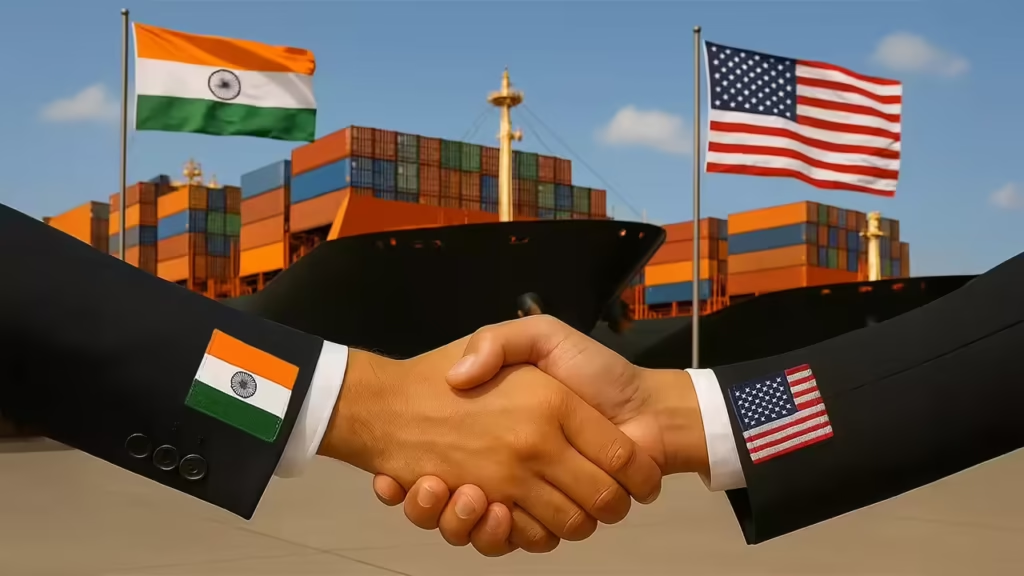
The India-US Trade Deal 2025 marks a major economic step between New Delhi and Washington, reducing tariffs on selected exports, improving technology cooperation and expanding market access for Indian businesses. Policymakers and economists say the agreement could strengthen manufacturing, services and employment as global companies reorganise supply chains and search for alternatives to China.
What the India-US Trade Deal 2025 Changes
The agreement focuses on lowering import duties, reducing regulatory barriers and increasing cooperation in goods, services and technology trade. Trade specialists describe it not as a full free-trade agreement but as a targeted economic framework aimed at improving business predictability.
Lower tariffs reduce the cost of Indian exports entering the American market. This improves competitiveness and allows exporters to offer lower prices or retain higher margins.
Government officials involved in trade negotiations have indicated that companies now receive greater policy certainty, which is often as important as tariff cuts themselves. Businesses tend to invest more when they know rules will remain stable over the long term.
The agreement also includes digital trade cooperation and provisions supporting semiconductor and data-centre development. Economists say these provisions matter because modern trade increasingly involves services and data, not only physical goods.
Why Global Supply Chains Matter
China-Plus-One Strategy
Over the past decade, global companies have gradually moved part of their manufacturing away from China. Trade tensions, pandemic disruptions and rising labour costs encouraged businesses to diversify production locations.
Economists call this shift the “China-plus-one” strategy. It means firms keep operations in China but add a secondary production base elsewhere.
India has sought to capture this opportunity but previously faced tariff disadvantages in major markets. The India-US Trade Deal 2025 narrows that gap and improves its attractiveness as a manufacturing destination.
Analysts note that international buyers often choose suppliers based on cost, reliability and policy stability. The agreement strengthens India’s position in all three areas.

India-US Trade Deal 2025
| Area | What Changes | Expected Impact | Timeframe |
|---|---|---|---|
| Tariffs | Lower duties on selected exports | Improved competitiveness | Immediate |
| Technology | Cooperation in semiconductors and digital trade | Long-term industry growth | 3-10 years |
| Manufacturing | Increased export orders | Job creation | 2-5 years |
| Services | Stronger IT outsourcing demand | Higher revenue stability | 1-3 years |
| Supply Chains | Diversification away from China | Global manufacturing integration | Gradual |
Sector-by-Sector Impact
Chemicals and Specialty Manufacturing
Specialty chemicals are widely used in pharmaceuticals, electronics, agriculture and automotive industries. Analysts say these products are particularly sensitive to tariff changes because buyers often choose suppliers based on price differences of only a few percentage points.
Lower import duties may allow Indian companies to replace suppliers in markets traditionally dominated by East Asian manufacturers. Brokerage analysts consider this one of the earliest sectors likely to show results.
Pharmaceuticals
India is a major supplier of generic medicines to the United States. Expanded cooperation could simplify regulatory procedures and increase shipments.
Healthcare economists point out that generic medicines help reduce treatment costs in developed countries. Therefore, the agreement benefits both sides: Indian manufacturers gain export volume while U.S. healthcare providers obtain affordable drugs.
Pharmaceutical exports are also valuable because they rely on skilled labour and research capacity, supporting high-quality employment.
Information Technology and Digital Services
The United States remains the largest market for India’s IT and business-process outsourcing sector. The agreement strengthens digital trade relations and encourages long-term contracts.
Industry associations say cooperation in semiconductor design, cloud computing and artificial intelligence infrastructure could expand the technology partnership beyond traditional outsourcing.

Textiles and Apparel
Garments and footwear industries employ millions of workers. Even small tariff reductions can significantly affect orders because international retailers compare suppliers globally.
Economists say export growth in textiles could help employment, particularly in labour-intensive manufacturing regions.
Engineering Goods, Aerospace and Defence
The agreement also expands cooperation in advanced manufacturing. Indian companies may produce aircraft components, industrial machinery parts and maintenance services.
Experts note that aerospace supply chains are long-term relationships. Once suppliers are certified, they often remain partners for decades.
Gems and Jewellery
The United States is among the largest buyers of Indian polished diamonds and jewellery. Reduced trade barriers may increase shipments from manufacturing and trading centres, particularly in western India.
Industry groups say the sector is highly export-oriented and sensitive to duty changes.
Wider Economic Effects
Banking and Logistics
Export expansion typically increases demand for trade financing, shipping insurance and port operations. Economists say logistics infrastructure becomes crucial once trade volumes rise.
Ports, freight operators and shipping companies may therefore benefit indirectly from the agreement.
Employment and Manufacturing
Manufacturing growth tends to create jobs across multiple skill levels. Labour-intensive sectors such as textiles and assembly production could generate large numbers of entry-level positions.
Policy planners see this as important because employment growth is a central economic objective.
Technology Cooperation
The digital provisions indicate deeper cooperation in advanced technology areas, including semiconductor supply chains and data infrastructure.
These industries require high investment but can generate long-term productivity gains.
What It Means for Consumers
Trade agreements often appear distant from everyday life, but their effects can reach consumers.
Lower tariffs can reduce prices of imported goods and increase availability of products. Export growth can also improve wages and employment in manufacturing regions.
For example:
- Cheaper generic medicines may reduce healthcare costs abroad.
- Increased manufacturing may create jobs domestically.
- Technology cooperation could improve digital services and infrastructure.
Risks and Challenges
Despite optimism, economists warn benefits are not automatic.
India still faces:
- Infrastructure bottlenecks
- High logistics costs
- Complex regulatory procedures
- Skill shortages in manufacturing
If these issues persist, exporters may struggle to scale production.
Global economic conditions also matter. A slowdown in U.S. demand would reduce the agreement’s immediate impact.
Strategic Context
The agreement also reflects broader geopolitical alignment. India and the United States increasingly cooperate in trade, technology and regional security.
Trade experts note economic partnerships often support strategic relationships. Supply-chain resilience has become a priority for many countries seeking to reduce reliance on single manufacturing sources.
The agreement therefore carries both commercial and strategic significance.
Historical Background
Trade relations between the two countries have expanded steadily over the past two decades. Bilateral trade has grown from modest levels in the early 2000s to one of the world’s largest commercial relationships.
However, previous negotiations for a comprehensive free-trade agreement did not succeed. The 2025 framework represents a more targeted approach, focusing on achievable areas such as tariff reduction and technology cooperation.
Analysts say such “limited trade agreements” are increasingly common because full free-trade agreements are politically complex.
Global Comparison
Economists compare the agreement with similar partnerships involving Vietnam, Mexico and Southeast Asian economies.
India’s advantages include:
- Large workforce
- Expanding domestic market
- Growing technology sector
Its disadvantages include:
- Higher logistics costs
- Land acquisition challenges
- Slower manufacturing approvals
The agreement helps address some but not all of these issues.
Conclusion
The India-US Trade Deal 2025 could significantly influence India’s economic development by improving export competitiveness and encouraging investment. Early gains may appear in chemicals, pharmaceuticals and textiles, while long-term impact could emerge in technology and advanced manufacturing.
However, economists stress that domestic reforms and infrastructure improvements will determine how fully India benefits. The agreement provides opportunity, but policy execution will decide the outcome.