
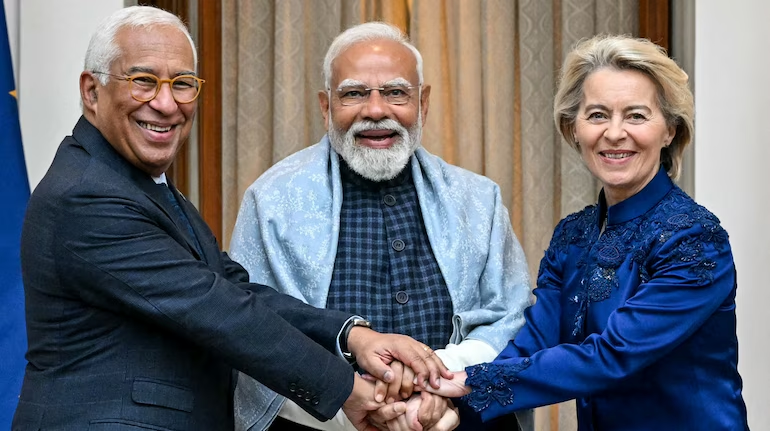
India has signed two major international agreements within a fortnight, concluding separate trade arrangements with the United States and the European Union in early 2026. The move — widely described as a turning point in economic diplomacy — places India Seals 2 Global Deals in 2 Weeks at the centre of global commerce while raising questions about domestic industry competitiveness and long-term geopolitical positioning.
India Seals 2 Global Deals in 2 Weeks
| Area | Key Takeaway |
|---|---|
| Trade Access | India gains preferential access to two of the world’s largest consumer markets |
| Tariff Cuts | Gradual reduction of import duties on industrial and consumer goods |
| Export Growth | Textiles, pharmaceuticals, and IT services expected to benefit most |
| Domestic Risk | MSMEs, agriculture and automobile sector face stronger foreign competition |
| Geopolitics | India deepens economic engagement with Western economies |
| Long-Term Goal | Integration into global supply chains and manufacturing relocation from China |
Why the Agreements Matter
The European Union agreement was finalised on 27 January 2026 after nearly two decades of intermittent negotiations. Days later, India announced a separate arrangement with Washington focused on market access, technology, and energy trade.
Together, the two accords cover markets accounting for roughly half of India’s exports.
Officials in the Ministry of Commerce said the objective is to “accelerate export-led growth and strengthen India’s position in global supply chains.”
Trade economists interpret the timing as strategic rather than coincidental.
India is increasingly viewed by Western governments and multinational firms as a production alternative amid supply disruptions and geopolitical tensions.
Background: From Protectionism to Integration
For decades after independence, India followed a highly protectionist economic model. Import duties were among the highest in the world, and foreign companies faced strict restrictions.
The country began opening its economy in 1991 after a balance-of-payments crisis forced major reforms. Tariffs were gradually reduced, foreign investment rules eased, and private industry expanded.
However, even after liberalisation, India remained cautious in signing large free trade agreements. Several earlier deals with Asian partners drew criticism from domestic manufacturers who said cheap imports hurt local production.
The new pacts signal a more confident approach to international trade policy.
The European Union Agreement
Market Access
The EU is India’s second-largest trading partner. The new free trade agreement India framework will eliminate tariffs on most Indian exports over time.
Industries expected to benefit include:
- apparel and textiles
- leather goods
- jewellery and gems
- engineering products
European tariffs on many of these goods previously ranged from 8% to 16%.
India’s Commitments
India will gradually reduce duties on European goods, including:
- high-end automobiles
- industrial machinery
- wine and luxury consumer products

Environmental Standards
The EU agreement also includes sustainability conditions related to labour and climate regulations. Indian exporters must meet environmental certification requirements.
Trade policy analyst Dr. Biswajit Dhar said smaller firms may struggle initially.
“Compliance costs will rise, but companies that adapt can access premium global markets,” he said.
The United States Agreement
Energy and Technology Cooperation
The United States is India’s largest export destination. The bilateral arrangement emphasises strategic trade partnerships rather than a full free trade pact.
India will expand purchases of:
- liquefied natural gas
- aviation equipment
- advanced technology systems
In return, selected tariff cuts on Indian exports such as engineering goods and manufacturing products are expected.

Strategic Implications
Foreign policy experts say the deal carries geopolitical weight.
Economic cooperation often influences diplomatic alignment.
Former ambassador T.P. Sreenivasan noted:
“Trade partnerships increasingly determine international relations. Economic interdependence creates strategic proximity.”
Sector-Wise Impact Inside India
Sectors Likely to Gain
- Pharmaceuticals – Easier regulatory approvals may expand exports.
- Information Technology – Services sector benefits from market access.
- Textiles and garments – Tariff cuts improve price competitiveness.
- Electronics manufacturing – Foreign investment expected to rise.
Sectors Facing Pressure
- Automobile industry – Competition from imported vehicles
- Dairy sector – Concern about foreign agricultural imports
- Small manufacturers – Increased competition from global firms
Economist Arvind Panagariya said adjustment is inevitable in trade reforms.
“Trade agreements create efficiency but require transitional support for affected workers.”
Impact on Employment and Investment
The government expects the deals to attract foreign direct investment into manufacturing. Multinational companies seeking production bases outside East Asia may expand operations in India.
Supporters say this could generate jobs in:
- electronics assembly
- renewable energy equipment
- industrial machinery
However, labour economists caution job creation may take time as industries restructure.
The Global Supply Chain Context
Since the COVID-19 pandemic and subsequent geopolitical tensions, companies have been diversifying production locations. Governments in North America and Europe have encouraged businesses to reduce dependence on single manufacturing hubs.
India offers:
- a large labour force
- expanding infrastructure
- improving logistics networks
By signing agreements with both the EU and U.S., India positions itself as a reliable manufacturing partner in reconfigured global supply chains.
Trade Balance Concerns
Some economists warn increased imports may widen India’s trade deficit in the short term.
If domestic consumption of foreign goods rises faster than exports, the current account balance could deteriorate.
The Reserve Bank of India has previously cautioned that trade liberalisation requires careful macroeconomic management.
Political and Diplomatic Implications
The agreements also affect India’s foreign policy calculus. While India maintains a multi-aligned diplomacy, closer economic engagement with Western economies may influence future strategic decisions.
Analysts emphasise that India continues relations with multiple partners, but trade patterns often shape diplomatic priorities.
Public Reaction
Business associations welcomed the agreements, calling them necessary for export growth. Several manufacturing groups said the pacts will help integrate Indian firms into international markets.
However, farmer organisations expressed concern about agricultural competition. They have requested safeguards and gradual implementation.
The government has indicated it may provide adjustment support schemes for vulnerable sectors.
Long-Term Outlook
Economists broadly agree the success of India Seals 2 Global Deals in 2 Weeks depends on domestic reforms. Key requirements include:
- improved logistics infrastructure
- labour skill development
- faster customs clearance
- stable regulatory policies
If implemented effectively, India could increase its share of global exports over the next decade.
If reforms lag, the country may face higher imports without corresponding export growth.
Conclusion
India’s two trade agreements represent one of the most significant economic policy shifts since liberalisation reforms three decades ago. The deals open vast international markets and deepen strategic trade partnerships, but they also expose domestic sectors to competition. Their ultimate impact will depend on how quickly industry adapts and how effectively policymakers manage the transition.