

The decision to launch this massive OFS in IRFC is a strategic maneuver by the central government to meet two primary objectives: adhering to regulatory compliance and raising essential funds for the exchequer. By utilizing the Offer for Sale route, the promoter is effectively increasing the supply of shares in the open market by millions of units overnight. This specific corporate action is designed to offload up to a four percent stake in the state-run financier, which naturally creates a temporary supply overhang.

For investors, the massive OFS in IRFC is not just a headline; it is a direct event that influences portfolio value. The government has set a floor price that is at a discount to the prevailing market rate, which invariably pulls the stock price down to match the offer. Understanding the base offer size, the green shoe option, and the floor price is essential for spotting the right entry levels in this volatile environment.
Government of India Shocks Markets with Massive OFS in IRFC
| Parameter | Offer Details |
| Seller | Government of India (Ministry of Railways) |
| Base Offer Size | 2% of paid-up capital (26.13 crore shares) |
| Green Shoe Option | Additional 2% (26.13 crore shares) |
| Total Potential Sale | Up to 4% stake (52.27 crore shares) |
| Floor Price | ₹104 per equity share |
| Estimated Fund Raising | Approx. ₹5,430 crore – ₹5,436 crore |
| Non-Retail Bidding Date | February 25, 2026 |
| Retail Bidding Date | February 26, 2026 |
| Current Promoter Holding | 86.36% (Pre-OFS) |
The massive OFS in IRFC is a significant event in the Indian stock market calendar for 2026. It highlights the government’s commitment to divestment and market reforms. While the immediate reaction has been a decline in share price, the long-term fundamentals of the Indian Railway Finance Corporation remain unaltered and attractive. With a sovereign guarantee on its loans, zero NPAs, and a consistent dividend yield, IRFC remains a defensive stronghold in a volatile market. For the astute investor, this shock share sale is less of a warning sign and more of an invitation to accumulate quality assets at a reasonable price. As the bidding windows close and the dust settles, the focus will inevitably shift back to the company’s pivotal role in powering the nation’s railway infrastructure.
The Mechanics of the Offer Structure and Timeline
- The execution of this share sale is not a chaotic event but a highly structured process spread over two specific trading days. The timeline is critical for investors to note. The bidding process for this massive OFS in IRFC officially kicked off on February 25, 2026. This first day is exclusively reserved for non-retail investors. This category includes the heavy hitters of the financial world mutual funds, foreign portfolio investors, insurance companies, and high-net-worth individuals. These participants typically place bids for large volumes, setting the tone for the demand.
- The second day, February 26, 2026, is when the window opens for the retail investor the everyday individual looking to buy shares for their personal portfolio. It is also the day when eligible employees of the company can place their bids. The government has structured the transaction with a base offer of a two percent stake, amounting to roughly 26.13 crore shares. However, to ensure they can capture higher demand if it exists, they have included a green shoe option. This allows them to retain oversubscription for an additional two percent. If institutional interest is high on day one, the government can exercise this option to sell a total of four percent equity. This mechanism ensures that the government can maximize its fundraising without depressing the stock price unnecessarily if demand is weak.
Understanding Pricing Allocation and Reservation
- One of the most attractive aspects of this sale for potential buyers is the pricing strategy. To incentivize participation in the massive OFS in IRFC, the government has set the floor price at ₹104 per share. At the time of the announcement, this represented a discount of nearly 5% to the closing market price. The floor price acts as a hard boundary the exchange systems will automatically reject any bid placed below ₹104. This discount provides a margin of safety for new entrants, theoretically limiting the downside risk in the immediate term.
- Allocation is another key area where the government has tried to ensure fairness. A minimum of 25% of the offer is strictly reserved for mutual funds and insurance companies. This is a strategic move to ensure that a significant chunk of the shares ends up in strong hands institutional investors who are likely to hold the stock for the long term rather than flipping it for a quick profit. For retail investors, 10% of the offer size is reserved. A distinct advantage for retail participants is the ability to bid at the “cut-off price.” Unlike institutions that must bid at a specific price, retail investors can simply agree to buy at whatever final price is discovered during the bidding process, ensuring they don’t miss out on allotment due to a pricing error.
The Strategic Push for Regulatory Compliance
- While the immediate impact is a drop in stock price, it is important to understand why the government is doing this. The primary motivation behind the massive OFS in IRFC goes beyond just raising capital; it is about regulatory hygiene. The Securities and Exchange Board of India (SEBI) has strict Minimum Public Shareholding (MPS) norms that mandate all listed companies to have a public float of at least 25%. This means the promoter (in this case, the government) cannot hold more than 75% of the company indefinitely.
- Before this offer, the government held a staggering 86.36% stake in the company. This low public float often leads to lower trading liquidity and can sometimes result in inflated valuations due to scarcity of shares. By executing this sale, the promoter holding will drop to around 82.36%. While this is still above the 75% threshold, it is a significant step toward compliance. Investors should be aware that because the holding is still above 75%, there will likely be more such stake sales in the future. However, these are usually spaced out over time to avoid crashing the market.
Financial Strength Amidst Market Noise
It is easy to get lost in the noise of stock price fluctuations and forget the underlying business. Despite the negative sentiment caused by the massive OFS in IRFC, the company’s financials remain robust. In its Q3 FY26 earnings report (for the period ending December 2025), IRFC posted its highest-ever quarterly net profit of ₹1,802 crore. This represents an 11% year-on-year growth, a figure that many private sector non-banking financial companies (NBFCs) would envy. The company’s business model is incredibly resilient. IRFC is essentially the financing arm of the Indian Railways. It borrows money from the markets at very low rates (thanks to its high credit rating) and lends it to the Railways to build infrastructure and buy rolling stock. Because the borrower is the government itself, the loans come with a sovereign guarantee. This means IRFC has zero Non-Performing Assets (NPAs). In a financial world where bad loans can sink massive banks, having a clean balance sheet with zero bad debt is a premium quality. As of December 2025, its Assets Under Management (AUM) stood at a record ₹4.75 lakh crore, showcasing the massive scale at which it operates.
Navigating Short Term Volatility for Long Term Gain
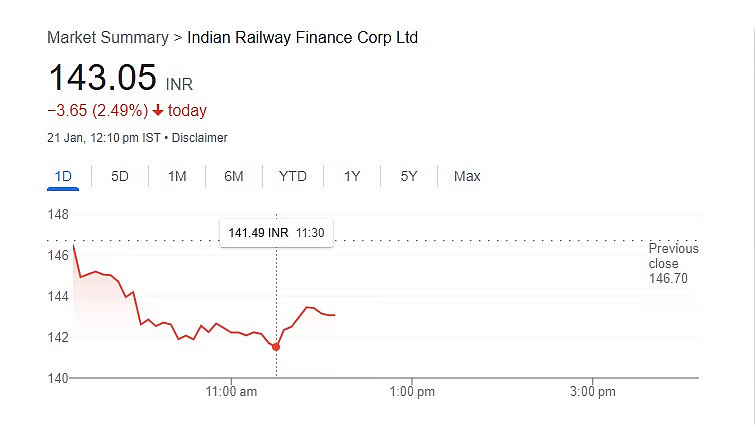
The market reaction to the massive OFS in IRFC has been predictable. When a large supply of shares hits the market at a discounted price, the market price naturally corrects to align with that floor price. This is simple supply and demand economics. Traders who bought the stock at higher levels might feel panic, but for long-term investors, this is often a buy the dip moment. The discount offered in an OFS is essentially an arbitrage opportunity. The market price usually hovers near the floor price during the bidding days but tends to stabilize once the supply is absorbed. For an investor who believes in the India growth story, specifically the infrastructure boom, IRFC is a proxy play. The Indian government is aggressively spending on railway modernization new Vande Bharat trains, track doubling, and station redevelopment. All of this requires money, and IRFC is the entity that provides that money. Therefore, as long as the Railways are growing, IRFC’s loan book will grow.
Strategic Advice for Retail Investors
- So, what should you do? If you are an existing shareholder, panic selling during the massive OFS in IRFC is rarely a good strategy. The price drop is technical, not fundamental. The company hasn’t lost money; the government is simply selling some of its shares. Selling now means booking a loss or reducing profit due to a temporary event.
- If you are a new investor, this event offers a clear entry point. The floor price of ₹104 acts as a strong support level. By participating in the retail category on February 26, 2026, you have the chance to pick up shares of a profit-making, dividend-paying PSU at a discount. However, do not expect immediate fireworks. After an OFS, stocks often remain range-bound for a few weeks as the market digests the new supply. The “green shoe” option means a lot of shares are changing hands, and it takes time for them to move from weak hands (short-term traders) to strong hands (long-term investors). Patience is the key here.
Read More:-
2027 Social Security COLA Forecast Revealed—Is This Modest Increase a Warning Sign for Retirees?
FAQs
What Is the Floor Price for The Massive OFS In IRFC?
The floor price has been set at ₹104 per equity share. This is the minimum price at which bids can be placed. Any bid below this price will be rejected.
Who Is Eligible to Participate in The Retail Category?
Any individual investor who places a bid for a total value of ₹2 lakh or less is considered a retail investor. The retail window opens specifically on the second day of the offer, which is February 26, 2026.
Why Is the Government Selling Its Stake in a Profitable Company?
The government is selling the stake to comply with SEBI’s Minimum Public Shareholding norms, which require listed companies to have at least 25% public shareholding.
Does This OFS Dilute the Earnings Per Share (EPS)?
No. An Offer for Sale involves the transfer of existing shares from the promoter to the public. No new shares are created, so the total number of shares in the company remains the same, meaning the EPS is not diluted.