

The AI ‘Tsunami’ could affect nearly 40% of jobs worldwide, according to the International Monetary Fund (IMF), whose managing director warned that artificial intelligence is set to transform the labor market across both advanced and developing economies. The remarks, delivered during international economic discussions in early 2026, have intensified debate about automation, economic growth, and whether workers can adapt quickly enough.
AI ‘Tsunami’
| Key Fact | Detail/Statistic |
|---|---|
| Global job exposure | Around 40% of jobs affected |
| Advanced economies | Up to 60% impacted |
| Nature of impact | Jobs will change more than disappear |
| Most vulnerable | Entry-level routine office roles |
Experts say the transition will occur gradually rather than overnight. The key uncertainty is whether education systems and training programs can evolve quickly enough. The IMF maintains that the outcome of the AI ‘Tsunami’ will depend less on technology itself and more on how governments, businesses, and workers respond.
What the IMF Means by the AI ‘Tsunami’ Warning
Kristalina Georgieva, Managing Director of the International Monetary Fund (IMF), said artificial intelligence may transform employment at a pace faster than previous technological revolutions.
“The world is entering a profound technological transition,” she said in a policy speech. “Artificial intelligence could boost productivity but also disrupt livelihoods if societies are not prepared.”
Economists stress that the warning does not predict mass unemployment. Instead, it suggests a large-scale restructuring of work. The IMF estimates roughly two out of five jobs will see significant task changes.
Many roles will still exist, but workers will perform them differently.
Automation vs. Replacement
Labor economists distinguish between occupations and tasks. AI systems typically replace repetitive activities rather than entire professions.
Dr. Daron Acemoglu of the Massachusetts Institute of Technology has written that automation “reallocates labor rather than simply eliminating it.” New occupations often emerge alongside technological adoption.
For example, ATMs reduced some bank teller duties but expanded customer service roles and financial advising positions. The IMF argues artificial intelligence may follow a similar pattern.
Which Jobs Face the Highest Exposure
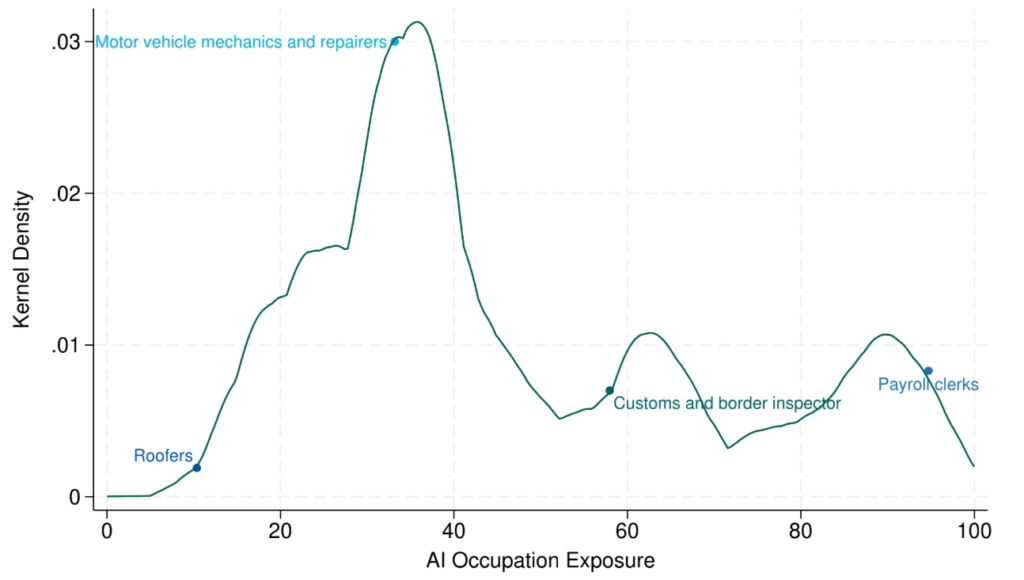
The IMF identifies clerical and administrative occupations as the most exposed to the automation jobs risk created by advanced AI systems.
High Exposure
- Data entry operators
- Basic accountants
- Telemarketers
- Administrative assistants
- Customer support agents
These jobs involve predictable workflows. Artificial intelligence systems excel at processing structured information, answering routine queries, and generating documents.
Medium Exposure
Professional knowledge work may also change significantly:
- Junior lawyers
- Entry-level programmers
- Research assistants
- Translators
Lower Exposure (future of work)
Roles requiring human interaction, trust, or unpredictable environments remain less susceptible:
- Nurses
- Electricians
- Construction workers
- Teachers
- Supervisors and managers
The Organisation for Economic Co-operation and Development (OECD) similarly reports that social intelligence and physical adaptability remain difficult to automate.
Why Younger Workers May Feel the Impact First
IMF researchers warn early-career workers face a particular challenge. Entry-level positions often consist of routine tasks — data processing, scheduling, and documentation — which artificial intelligence can now perform quickly.
That could make it harder for graduates to gain their first workplace experience.
Economists worry about a “training gap.” If entry-level roles shrink, companies may struggle to develop future senior professionals.
India and Emerging Economies
The impact may differ significantly by region. Advanced economies depend heavily on office-based knowledge work, which faces greater exposure.
Emerging economies such as India may initially see lower displacement because large parts of the workforce operate in services, retail, and physical trades. However, analysts warn another risk: fewer new office jobs could be created.
India produces millions of graduates annually, particularly in business administration and information technology. If companies automate entry-level clerical work, employment growth could slow for young professionals.
Technology researcher Nandan Nilekani, co-founder of Infosys, has said in public talks that artificial intelligence will not reduce the need for workers but will “change the nature of entry-level work significantly.”
Productivity Gains and Economic Growth (AI productivity)
Supporters of AI point to the technology’s economic potential. The IMF expects improvements in AI productivity, meaning workers could accomplish more in less time.
Businesses are already using AI to:
- analyze large datasets
- automate reporting
- optimize logistics
- assist decision-making
The World Bank notes that technological change historically increases overall wealth even when specific jobs decline. The rise of the internet created industries such as app development, cybersecurity, and digital marketing.
Case Study: A Changing Office Job
Consider a typical accounting office.
In the past, junior staff manually entered invoices, verified calculations, and prepared financial reports. Today, AI software can scan receipts, categorize expenses, and produce reports automatically.
Instead of performing calculations, employees now review automated outputs and advise clients.
The job still exists — but the tasks have changed.
Governments and Businesses Preparing
Several countries have launched workforce reskilling initiatives.
The United States, European Union, and Singapore have expanded digital skills training programs. Some governments are subsidizing education in data analysis, software literacy, and technical oversight.
Companies are also redesigning workflows to combine human judgment with AI analysis. Rather than replacing workers, many firms are restructuring roles.
Corporate leaders increasingly state a simple rule: workers who use AI may replace workers who do not.
Broader Historical Context
Technological disruption is not new.
- Mechanization reduced agricultural jobs in the early 1900s.
- Industrial automation transformed manufacturing in the 1970s.
- Computers changed office work in the 1990s.
Each shift eliminated certain occupations but created others. The difference today is speed.
Digital technologies spread globally almost instantly. Artificial intelligence systems can be deployed across thousands of companies within months.
Brookings Institution analysts note that previous industrial revolutions affected physical labor. Artificial intelligence affects cognitive work — tasks involving reasoning and communication.
Social and Economic Risks
Economists warn that without preparation, inequality could widen.
Highly skilled workers may benefit from AI assistance, while routine workers may face wage pressure. Regions dependent on clerical employment could see economic disruption.
The IMF recommends:
- education reform
- social safety nets
- retraining programs
Failure to adapt could increase unemployment in specific sectors even if overall employment remains stable.
What Workers Can Do Now
Labor specialists recommend preparation rather than resistance.
Key resilient skills include:
- critical thinking
- communication
- project management
- technical literacy
Experts describe the future workforce as “AI-augmented,” meaning people will collaborate with intelligent software.
The most valuable employees may be those who interpret, supervise, and validate automated systems.
Current Outlook
The IMF urges policymakers to act early. Education systems may need updating to teach adaptable skills rather than narrow specializations.
Georgieva emphasized that policy decisions will determine outcomes.
“Our responsibility,” she said, “is to ensure artificial intelligence benefits society broadly.”
FAQ
Will the AI ‘Tsunami’ cause mass unemployment?
No. Economists expect job transformation more than elimination.
Which workers are most affected?
Routine administrative and entry-level office roles.
Which jobs are safest?
Human-interaction and skilled trade professions.
What should workers learn?
Digital literacy, communication, and analytical skills.