

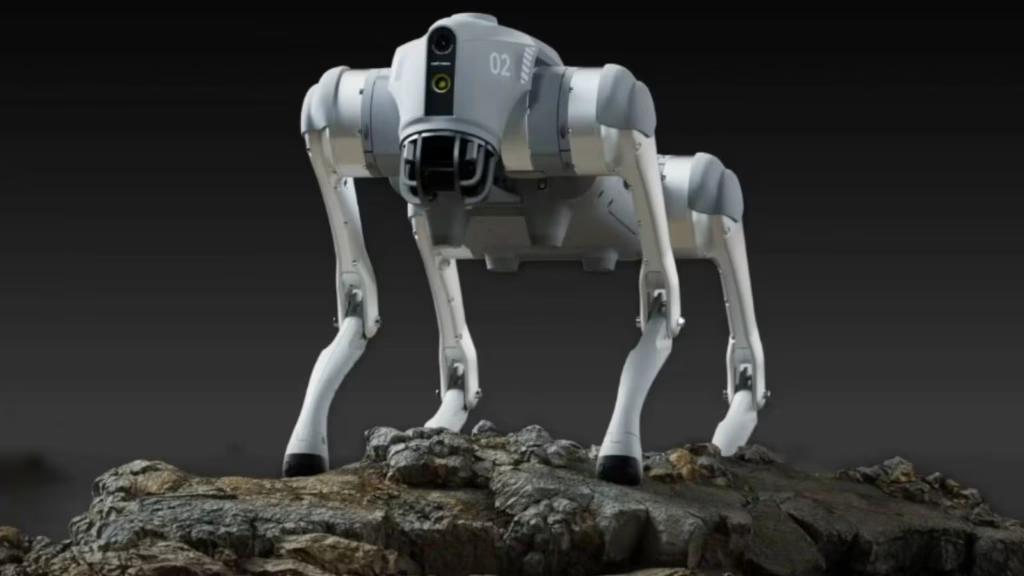
An AI-Powered Robotic Dog known as the Unitree Go2 gained national attention in India after a public demonstration linked to an artificial intelligence event near Delhi. The lifelike machine’s autonomous movement drew crowds and sparked debate, while also highlighting a broader shift: advanced robotics technology is no longer confined to elite laboratories and is becoming accessible to universities, companies, and public agencies.
AI-Powered Robotic Dog
| Key Fact | Detail |
|---|---|
| Robot Identity | Commercial quadruped robot developed by Unitree Robotics |
| Core Technology | Uses LiDAR mapping and autonomous navigation |
| Public Reaction | Viral demonstration triggered scrutiny and curiosity |
| Broader Significance | Shows expansion of service robotics beyond research labs |
As robotics technology becomes more common, demonstrations like the AI-Powered Robotic Dog are likely to increase. Researchers say the central issue is no longer whether robots can function in human environments, but how societies will regulate, trust, and integrate machines that increasingly share public spaces with people.
The AI-Powered Robotic Dog and the Viral Demonstration
The robot appeared during a public technology showcase connected to an AI summit in India’s National Capital Region. Videos showed the four-legged machine walking through a crowd, greeting visitors, and avoiding obstacles without direct manual control.
Viewers quickly recognized the device as the Unitree Go2, manufactured by Unitree Robotics, a Chinese robotics company established in 2016.
International news coverage reported that officials raised concerns about how the device was presented after observers identified it as a commercial platform rather than a student-built prototype. Regardless of the dispute, the demonstration exposed a wider public audience to a sophisticated category of machines: autonomous quadruped robots.
For many spectators, the most striking feature was not its appearance but its behavior. The robot moved smoothly, paused near people, and adjusted direction in real time. Robotics engineers say such behavior signals a major technological milestone — machines navigating human spaces safely.
How the AI-Powered Robotic Dog Works
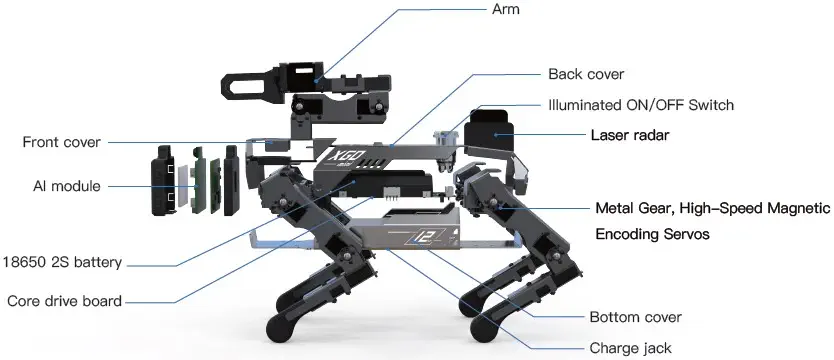
AI Navigation and 4D LiDAR
The Unitree Go2 relies on Light Detection and Ranging (LiDAR), a laser-based sensor system used in autonomous vehicles. The scanner continuously measures distances around the robot and generates a three-dimensional map of the environment.
The robot processes this information using onboard computing, enabling autonomous navigation. It identifies walls, stairs, people, and furniture, then adjusts its walking path accordingly.
Robotics researchers say this type of perception system is essential if robots are to function in public spaces.
Dr. Aaron Johnson, a robotics engineer at Carnegie Mellon University, has explained in academic discussions:
“Robots need spatial awareness similar to animals. Without perception, they cannot safely operate around humans.”
Dynamic Balance and Movement
Unlike wheeled machines, a quadruped robot must constantly balance. Each leg contains electric motors and force sensors that measure pressure hundreds of times per second.
The onboard processor calculates body position and redistributes weight across the legs. If the robot is pushed, it automatically regains stability.
This process, called dynamic locomotion, resembles biological walking. Engineers often study animal motion to design such systems.
Why Universities and Researchers Use It
Historically, legged robots were rare because of high costs and mechanical complexity. Research platforms sometimes cost hundreds of thousands of dollars.
The Unitree Go2 lowered that barrier. Its comparatively lower price and programmable software tools allow universities to experiment with robotics and machine learning.
Typical academic uses include:
- reinforcement learning experiments
- motion planning algorithms
- robotic perception research
- human-robot interaction studies
Professor Ken Goldberg of the University of California, Berkeley, has emphasized in academic commentary that robotics education requires physical experimentation:
“Simulation is useful, but real-world interaction reveals the true challenges robots face.”
Students can program the robot to follow a person, map a building, or inspect a space autonomously. The value lies in the software and experiments rather than the mechanical construction.
Expanding Uses: Security, Inspection, and Disaster Response
Industry and government agencies are exploring real-world applications for service robotics platforms.
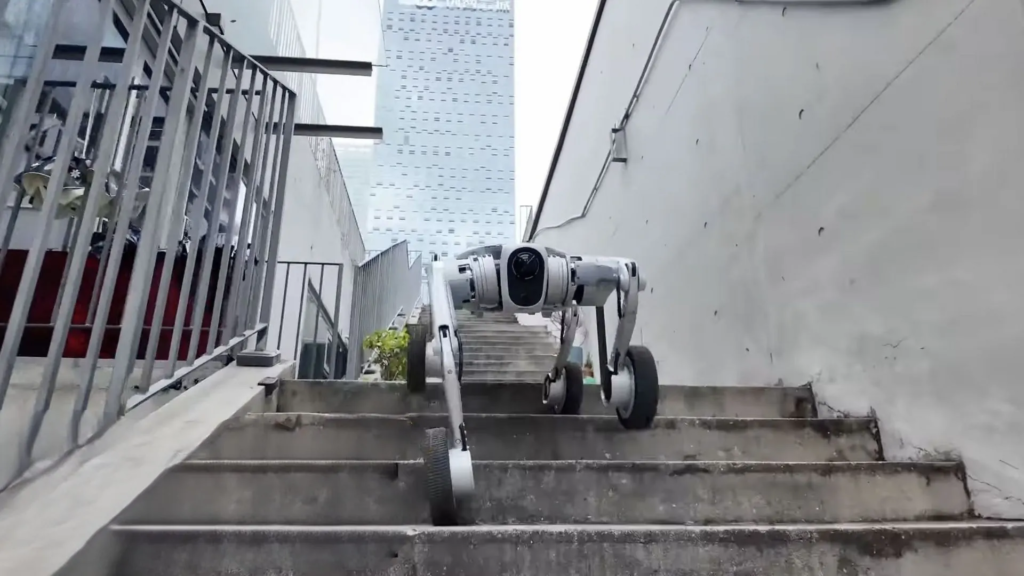
Because an AI-Powered Robotic Dog can climb stairs and operate in tight spaces, it may perform tasks too risky for humans. These include:
- inspecting power plants
- checking pipelines
- surveying collapsed buildings
- monitoring hazardous areas
In disaster response, robots can enter environments with fire, toxic gas, or structural instability. Researchers in emergency robotics say legged machines are particularly useful because disaster zones rarely contain smooth surfaces.
Security agencies are also studying robotic patrol systems for large facilities such as airports, warehouses, and campuses.
Global Competition in Robotics
The emergence of the AI-Powered Robotic Dog reflects a wider technological race. Countries including the United States, China, Japan, and South Korea are investing heavily in robotics development.
Boston Dynamics in the United States produces the industrial quadruped “Spot,” while Japanese firms focus on service and elder-care robots. Analysts say China has rapidly expanded manufacturing capacity in robotics hardware.
The International Federation of Robotics reports that service robotics is one of the fastest-growing segments of automation. Mobile inspection robots are increasingly deployed in energy, mining, and infrastructure sectors.
Lower production costs and improved batteries have accelerated adoption. What once required specialized laboratories can now be purchased as a research platform.
Ethical and Privacy Questions
The spread of autonomous machines has also raised ethical concerns.
Privacy experts warn that mobile robots equipped with cameras could collect sensitive information in public spaces. The Brookings Institution has previously noted that robotic surveillance tools may require updated regulations.
Questions include:
- Who owns data collected by mobile robots?
- How should they operate in schools or hospitals?
- Should autonomous machines be allowed to patrol public areas?
Robotics ethicist Dr. Kate Darling of the Massachusetts Institute of Technology has argued that public trust is essential:
“People must understand how robots function and what data they gather. Transparency matters more than novelty.”
Some cities are already drafting guidelines for robotic delivery vehicles and patrol machines.
Economic Impact
Economists say service robotics could affect labor markets, though not necessarily by replacing workers entirely.
Instead, robots may handle repetitive or dangerous tasks. Human workers may supervise systems rather than perform physical inspection.
The World Economic Forum has reported that automation often shifts job roles rather than eliminates them. New positions may emerge in robot maintenance, programming, and oversight.
In infrastructure maintenance, for example, a technician may remotely monitor multiple inspection robots rather than physically climbing towers or entering hazardous tunnels.
The Broader Debate About Robotics Accessibility
The controversy surrounding the demonstration also highlighted a misunderstanding about innovation.
Experts say modern technology development often involves integration rather than building every component independently. Students may use standardized hardware but create original software or applications.
Professor Robin Murphy of Texas A&M University has written in disaster robotics research:
“Progress frequently comes from applying existing systems in new ways.”
This mirrors computer programming education, where learning occurs through experimentation on available platforms.
Why the AI-Powered Robotic Dog Matters
The increasing visibility of the AI-Powered Robotic Dog signals a turning point in robotics adoption. Sensors, processors, and batteries have improved rapidly over the past decade.
Robots are moving from factories into human environments — offices, campuses, hospitals, and public infrastructure.
Researchers describe this as the transition from industrial automation to embodied artificial intelligence: machines interacting physically with society.
Within the next decade, analysts expect robots to assist with inspection, emergency response, and environmental monitoring.
FAQ
Is the AI-Powered Robotic Dog fully autonomous?
It can navigate and avoid obstacles independently but may also be controlled remotely.
Is it a toy?
No. It is a research and industrial platform used in education, inspection, and robotics development.
Why use legs instead of wheels?
Legs allow operation on stairs, debris, and uneven terrain.
Will robots replace workers?
Experts say robots will likely assist workers, especially in dangerous tasks.