

Artificial intelligence is reshaping the global labor market, and AI Is Creating 10 High-Paying Jobs that were rare or virtually nonexistent five years ago. Corporations across technology, healthcare, banking, and manufacturing are rapidly expanding hiring for specialized AI roles as automation and generative systems become central to operations. Economists describe the shift as a structural transformation rather than a temporary hiring trend.
The U.S. Bureau of Labor Statistics (BLS) projects employment in computer and information technology occupations will grow 13% from 2022 to 2032, much faster than the average for all occupations. The agency attributes much of that increase to expanding demand for artificial intelligence, cybersecurity, and cloud computing infrastructure.
AI Is Creating 10 High-Paying Jobs
| Key Fact | Detail / Statistic |
|---|---|
| AI job growth | 13% projected growth in IT occupations (2022–2032) |
| Corporate adoption | 75% of companies plan AI integration within five years |
| Economic value | Generative AI could add up to $4.4 trillion annually |
| Labor market impact | AI may affect 40% of global jobs |
Artificial intelligence is no longer a niche technology confined to research laboratories. It is becoming a foundational component of the global economy. As AI Is Creating 10 High-Paying Jobs, the broader question is whether education systems, policymakers, and workers can adapt quickly enough to ensure opportunity keeps pace with innovation.
AI Is Creating 10 High-Paying Jobs Across Multiple Sectors
The acceleration began in earnest following the 2022 public launch of generative systems such as OpenAI’s ChatGPT, which demonstrated how large language models could perform advanced reasoning and content generation. Since then, companies have created specialized roles to build, manage, and regulate AI systems.
The 10 Emerging High-Paying Roles
- Prompt Engineer
- Machine Learning Operations (MLOps) Engineer
- AI Data Engineer
- AI Ethics and Governance Specialist
- Large Language Model Product Strategist
- Robotic Process Automation Developer
- AI Security Analyst
- Cloud Architect for AI Infrastructure
- AI Solutions Consultant
- AI Content Strategist
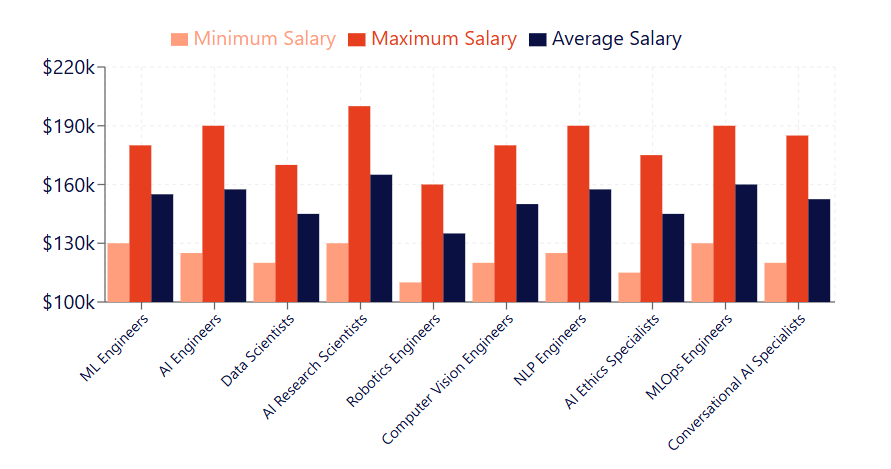
Many of these positions command salaries exceeding $120,000 annually in major U.S. metropolitan areas, according to compensation data from recruitment firm Robert Half and industry surveys compiled by LinkedIn.
“Demand is outpacing supply,” said Dr. Mark Muro, senior fellow at the Brookings Institution, in workforce research examining technology employment trends. “Companies need workers who understand both technical systems and business implementation.”
Why These AI Careers Pay a Premium
The wage growth reflects a combination of scarcity, complexity, and strategic importance.
Artificial intelligence systems require high-level mathematical modeling, cloud architecture design, cybersecurity safeguards, and regulatory compliance oversight. Employers report difficulty finding candidates who combine these skills with operational experience.
According to the World Economic Forum (WEF) Future of Jobs Report 2023, analytical thinking and AI literacy rank among the fastest-growing skills worldwide. Nearly 75% of surveyed firms expect to adopt AI technologies within five years.
The consulting firm McKinsey & Company estimates that generative AI alone could contribute between $2.6 trillion and $4.4 trillion annually to global economic output. That scale of investment has intensified competition for qualified professionals.
Secondary Keyword Focus: Workforce Transformation
The expansion of AI careers is part of a broader workforce transformation reshaping how organizations operate.
Historically, automation replaced routine manual tasks. Today’s AI systems increasingly affect cognitive tasks such as drafting reports, analyzing financial risk, and diagnosing medical conditions.
The International Monetary Fund (IMF) reported in January 2024 that artificial intelligence could affect nearly 40% of global employment, particularly in advanced economies where knowledge-based work dominates.
However, the IMF emphasized that while some roles may decline, new opportunities are likely to emerge alongside productivity gains.
AI Skills Gap Presents Major Challenge
Despite rapid job creation, a widening AI skills gap threatens to limit growth.
A 2023 study by Harvard Business School’s Project on Managing the Future of Work found that employers are increasingly hiring based on demonstrable skills rather than formal degrees. Certifications in cloud computing platforms such as Amazon Web Services (AWS) or Microsoft Azure often serve as alternatives to traditional credentials.
Yet experts warn that technical expertise alone is insufficient.
“Responsible AI deployment requires governance, ethics frameworks, and accountability mechanisms,” said Dr. Rumman Chowdhury, a recognized AI accountability specialist. “Without proper oversight, organizations face reputational and regulatory risk.”
The European Union’s AI Act, adopted in 2024, underscores the importance of compliance roles within the emerging AI ecosystem. Companies operating in Europe must now ensure AI systems meet strict safety and transparency standards, increasing demand for AI governance specialists.
Global Comparison: United States, Europe, and Asia
The growth of AI employment varies across regions.
In the United States, major technology hubs such as San Francisco, Seattle, and Austin lead hiring. Venture capital investment in AI startups reached record levels in 2023, according to data from PitchBook.
In Europe, AI job growth is closely linked to regulatory frameworks and public investment in digital infrastructure. Germany and France have expanded national AI strategies, funding research centers and public-private partnerships.
China, meanwhile, continues to invest heavily in artificial intelligence development as part of its long-term industrial strategy. Government policy emphasizes domestic semiconductor production and AI research, creating demand for engineers and system architects.
The Organisation for Economic Co-operation and Development (OECD) notes that countries investing in digital education and retraining programs are better positioned to capture economic benefits while limiting displacement.
Sector Spotlight: Healthcare, Finance, and Manufacturing
While early AI hiring centered in software firms, industry adoption has broadened significantly.
Healthcare systems now employ AI engineers to manage diagnostic imaging algorithms and predictive patient monitoring tools. Financial institutions rely on AI security analysts to detect fraud and manage algorithmic trading systems.
Manufacturers use machine learning models to optimize supply chains and predictive maintenance schedules. Retailers employ AI data engineers to refine demand forecasting and logistics planning.
The diversity of applications demonstrates how deeply artificial intelligence is embedding into operational systems worldwide.
Education and Retraining Efforts Expand
Governments and universities have responded with accelerated digital training programs.
The U.S. National Science Foundation has increased funding for artificial intelligence research and workforce development grants. Community colleges are launching short-term certification programs in machine learning and data analytics.
Online education platforms report surging enrollment in AI-related courses. Coursera stated in its 2024 Global Skills Report that generative AI courses ranked among the fastest-growing enrollments worldwide.
Yet access disparities remain. The Pew Research Center reported that higher-income and college-educated workers are more likely to benefit from AI integration, while lower-income workers face greater disruption risks.
Secondary Keyword Focus: Future of Work
The debate surrounding the future of work centers on whether artificial intelligence will ultimately widen or reduce inequality.
Proponents argue that AI increases productivity and generates new industries. Critics caution that benefits may concentrate among highly skilled workers and technology firms.
Economists at the OECD emphasize that public policy plays a decisive role.
“Technology outcomes are not predetermined,” OECD researchers wrote in a 2023 labor market outlook. “Education systems, social protections, and retraining initiatives shape how workers experience digital transformation.”
Long-Term Outlook
Most analysts agree that artificial intelligence will continue redefining professional roles over the next decade.
The World Economic Forum projects a net global shift in employment composition rather than wholesale job loss. New roles centered on AI system design, oversight, and optimization are expected to expand.
At the same time, policymakers face pressure to ensure inclusive growth. Labor advocates argue for stronger protections, while business leaders emphasize innovation and competitiveness.
The balance between opportunity and disruption remains central to the evolving debate.
FAQ
What industries are hiring AI professionals most aggressively?
Technology, healthcare, finance, retail, and manufacturing sectors show the strongest demand.
Do AI roles require advanced degrees?
Not always. Certifications, practical experience, and demonstrated technical proficiency increasingly matter as much as formal education.
Will AI eliminate more jobs than it creates?
Estimates vary. The IMF projects broad impact across occupations, while the World Economic Forum anticipates both job creation and displacement.