
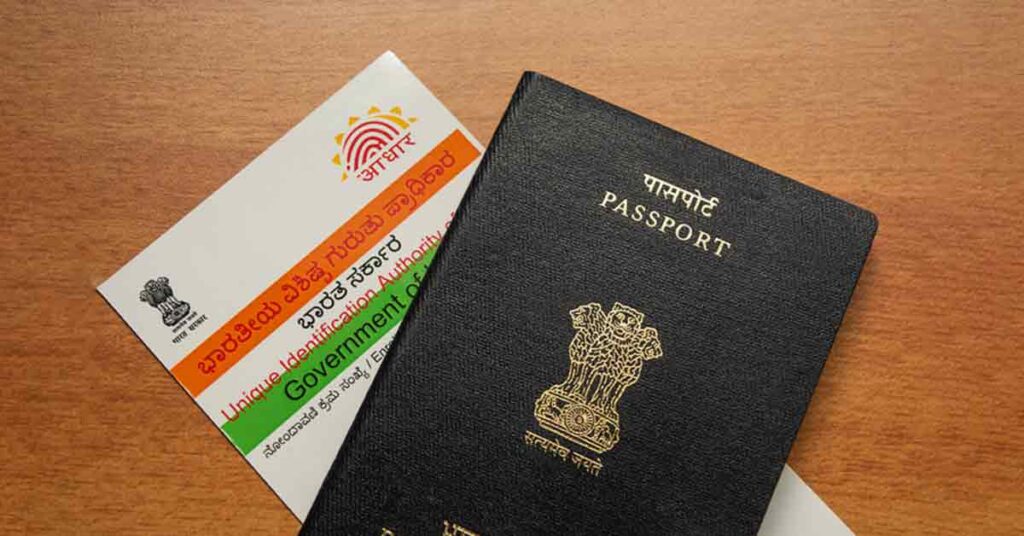
Across India, residents routinely submit identity documents for banking, employment verification, housing rentals and travel. Yet confusion remains over Aadhaar vs Passport, even though the documents serve separate legal purposes. Officials and legal experts say misunderstanding the difference can lead to immigration issues, documentation rejection, and identity fraud risks.
Aadhaar vs Passport
| Feature | Aadhaar | Passport |
|---|---|---|
| Issuing Authority | Unique Identification Authority of India (UIDAI) | Ministry of External Affairs (MEA) |
| Official Website | https://uidai.gov.in | https://passportindia.gov.in |
| What it proves | Identity of a resident | Citizenship of India |
| Eligibility | Residents living 182+ days in India | Only Indian citizens |
| International validity | Not valid abroad | Mandatory for international travel |
| Biometric data | Yes (fingerprint & iris) | No biometric authentication system |
| Legal strength | Identity authentication | Legal nationality certification |
| Validity | Generally lifelong | 10 years (adult) |
What Aadhaar vs Passport Actually Represents
India’s identity architecture relies on multiple documents issued by different authorities.
The Unique Identification Authority of India (UIDAI) provides Aadhaar numbers to residents who meet physical presence requirements in the country. The number is a 12-digit unique identifier linked to biometric and demographic data.
The Ministry of External Affairs (MEA) issues passports only after confirming citizenship through documentary checks and police verification under the Passports Act, 1967.
UIDAI states in public advisories:
“Aadhaar is proof of identity, not proof of citizenship.”
Legal scholars repeatedly emphasise the distinction.
Dr. Faizan Mustafa, a constitutional law scholar, has noted in academic lectures that Aadhaar confirms uniqueness in a database, whereas the passport confirms legal belonging to the Indian state.
Citizenship Proof: The Fundamental Difference
A central feature in the Aadhaar vs Passport debate concerns nationality.
Foreign nationals residing in India for long periods may obtain Aadhaar after meeting residency requirements. This includes some expatriate workers and long-term visa holders.
However, passports require citizenship verification.
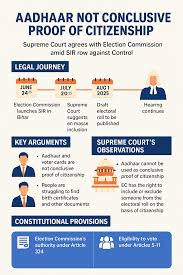
The Supreme Court of India, in its 2018 constitutional bench judgment on Aadhaar, clarified that Aadhaar cannot be treated as proof of citizenship or domicile.
Courts, embassies and universities abroad rely on passports because they represent state recognition of nationality.
How Each Document Is Used in Daily Life
Aadhaar: Digital Identity and Authentication
Aadhaar functions as a domestic verification system. It is widely used in:
- bank Know-Your-Customer (KYC) procedures
- mobile SIM verification
- public welfare distribution
- direct benefit transfers
The system enables electronic authentication through OTP or biometric confirmation. Government welfare programmes depend heavily on Aadhaar linkage to prevent duplicate beneficiaries.
UIDAI reports that billions of authentication transactions occur annually across banking and telecom sectors.
Passport: Legal Identity and International Mobility
The passport performs a different role entirely. It is required for:
- leaving or entering India
- visa applications
- immigration checks
- consular protection abroad
International travel rules follow standards of the International Civil Aviation Organization (ICAO), which recognises passports as primary travel identity documents.

Verification Standards: Why Governments Trust Passports More
The difference between Aadhaar vs Passport lies partly in verification depth.
Aadhaar enrolment requires submission of identity documents and biometric capture. Passport issuance involves additional police verification, address checks and citizenship documentation review.
Former immigration officers say this affects international acceptance.
“A passport holder has undergone background verification. That assurance does not exist with Aadhaar,” said a retired Indian immigration officer familiar with airport verification procedures.
Because of this, embassies and visa authorities do not accept Aadhaar for nationality verification.
Privacy, Data Security and Authentication
Aadhaar enables instant digital authentication, which has made it central to India’s digital economy.
However, privacy concerns have accompanied its expansion. The Supreme Court recognised privacy as a fundamental right and limited mandatory Aadhaar usage primarily to welfare schemes and regulated sectors.
Technology researchers explain that Aadhaar functions as an authentication system. Passports function as a certification document.
A passport number alone cannot verify identity electronically, but Aadhaar authentication can confirm a person’s presence in real time.
This difference affects fraud patterns. Financial identity fraud tends to involve Aadhaar misuse, while passport misuse typically involves travel or immigration violations.
Historical Context: Why India Created Aadhaar
The Aadhaar programme began in 2009 to streamline welfare distribution and reduce duplicate beneficiaries.
Before Aadhaar, India relied on multiple fragmented identity proofs such as ration cards, voter ID cards and local certificates. This made welfare delivery difficult in rural areas.
The government aimed to create a single nationwide identity database. Over time, banks and telecom companies adopted Aadhaar-based KYC because it reduced paperwork.
The passport system, by contrast, dates back decades and was designed primarily for international mobility rather than domestic governance.
Why Confusion Persists Among Citizens
Experts say confusion exists because people use Aadhaar more frequently in daily life.
Private entities often ask for “any ID proof.” As Aadhaar is convenient and widely available, citizens assume it has the same legal strength as a passport.
However, students applying to foreign universities, job seekers abroad and emigrants often discover the difference when institutions refuse Aadhaar as nationality proof.
The Ministry of External Affairs advises maintaining a valid passport even for citizens who do not travel frequently.
International Comparison: How Other Countries Handle Identity
India is unusual in having a universal biometric identity system separate from citizenship documentation.
In many countries:
- the passport is the primary identity document
- national ID cards often indicate citizenship
- biometric databases are limited to law enforcement use
India’s Aadhaar system instead functions as a public digital infrastructure for authentication. Economists describe it as a “platform identity system” supporting financial inclusion.
Practical Implications for Citizens
Understanding Aadhaar vs Passport can prevent administrative problems.
Use Aadhaar for:
- banking verification
- welfare benefits
- SIM activation
- domestic identification
Use Passport for:
- visa applications
- foreign education admissions
- employment abroad
- international travel
Legal professionals say document rejection is common when applicants submit Aadhaar instead of a passport in citizenship-related processes.
Expert Perspective
Policy analysts say the distinction will become more important as India expands digital services and cross-border mobility.
Identity verification systems increasingly rely on electronic authentication. However, nationality verification remains tied to sovereign documentation such as passports.
Experts recommend maintaining updated records in both systems rather than treating one as a substitute for the other.
Conclusion
India’s identity framework depends on multiple documents performing different functions. Aadhaar supports domestic digital authentication and welfare delivery, while the passport confirms nationality and enables international movement. Authorities and legal experts stress that misunderstanding Aadhaar vs Passport can cause legal complications, travel delays and verification failures as administrative systems become more interconnected.